
Driving Innovation

In 2026, one of the key buzzwords shaping the facilities management sector is disruptive innovation.
The term was coined by Clayton Christensen, an American academic and business consultant who developed the theory that has since been described as one of the most influential business ideas of the early 21st century. Its principles have been adopted across industries worldwide.
Disruptive innovation describes the process by which simpler, more affordable, or more convenient products or services begin in niche or overlooked markets and, over time, reshape the mainstream by changing customer expectations and established ways of working.
There are four main types of disruption:
Technological
Business model
Regulatory
Social movements
Within the cleaning and facilities industry, we have already begun to see this shift. In recent years, the sector has moved beyond traditional approaches — embracing technology-led solutions, smarter processes, and more sustainable practices. At Glen, our ambition is to continue evolving beyond “mops and buckets” into efficient, data-informed, and environmentally responsible solutions for our clients.
These changes will reshape service delivery, workforce models, cost structures, and client expectations. Our focus is to stay ahead of this evolution — ensuring innovation delivers real value, resilience, and long-term sustainability for the organisations we support.
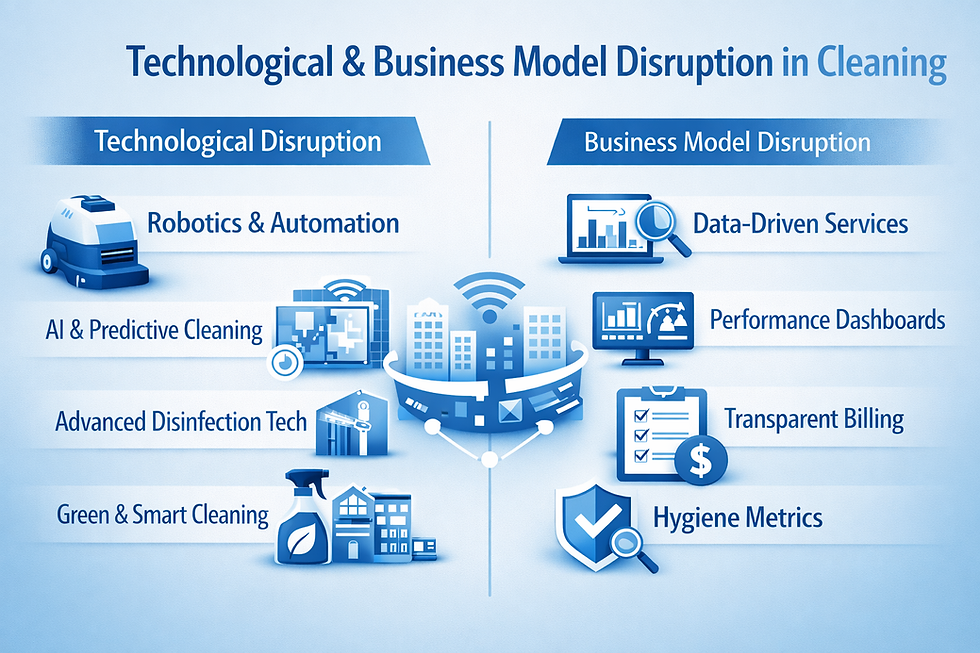
Technological & Business Model Disruption in Cleaning1. Technological DisruptionRobotics & Automation Robotic scrubbers and vacuums are already operating across parts of the industry. These systems reduce human error and optimise cleaning routes. The next phase is the move toward fully autonomous solutions — including self-charging, self-emptying machines and coordinated robot fleets — helping reduce labour dependency while improving consistency and reliability. AI, Sensors & Predictive Cleaning Cleaning is increasingly triggered by real usage data, occupancy levels, and contamination risk rather than fixed schedules. Once buildings are mapped, systems can provide real-time monitoring and prescriptive cleaning actions. Glen is actively working with clients to map buildings and explore these data-led approaches. Disinfection Technologies Emerging solutions such as UV-C, far-UV, plasma, and photocatalytic systems offer chemical-free disinfection options. We continually review product availability, effectiveness, and cost-benefit to ensure solutions are both practical and proportionate. Nanotechnology & Surface Engineering Self-cleaning, antimicrobial, and dirt-repellent coatings can reduce cleaning frequency and support longer-term hygiene performance. Future buildings are increasingly being designed with “clean-by-design” materials, and developments in this area continue to evolve rapidly. Green Chemistry & Zero-Emission Cleaning Enzymatic and biological cleaning products are beginning to replace traditional chemicals. Combined with water-recycling systems and VOC-free solutions, these approaches support sustainability and ESG goals. Glen is keen to further develop the use of these products where they add real value. Hyper-Connected Smart Cleaning Networks Smart surfaces and systems can signal cleanliness status and integrate with wider building infrastructure — including HVAC, lighting, and occupancy systems — enabling a more connected and responsive facilities environment. |
2. Business Model DisruptionThe industry is moving away from blanket, standardised cleaning schedules toward data-led, dynamic service models. These approaches focus on actual need rather than assumptions. Key developments include:
For clients, this means improved visibility, clearer outcomes, and services that are aligned more closely with how buildings are actually used. |

